Cognitive Longevity System

Live longer. Think better. Stay independent.

Cognitive decline doesn't have to be inevitable. CogniFit's personalized brain training targets the memory, attention and processing speed that decide how independently you live as you age.

★★★★★ 4.8 on the App Store · 6M+ users worldwide

Designed to support general cognitive wellbeing. Individual results may vary.
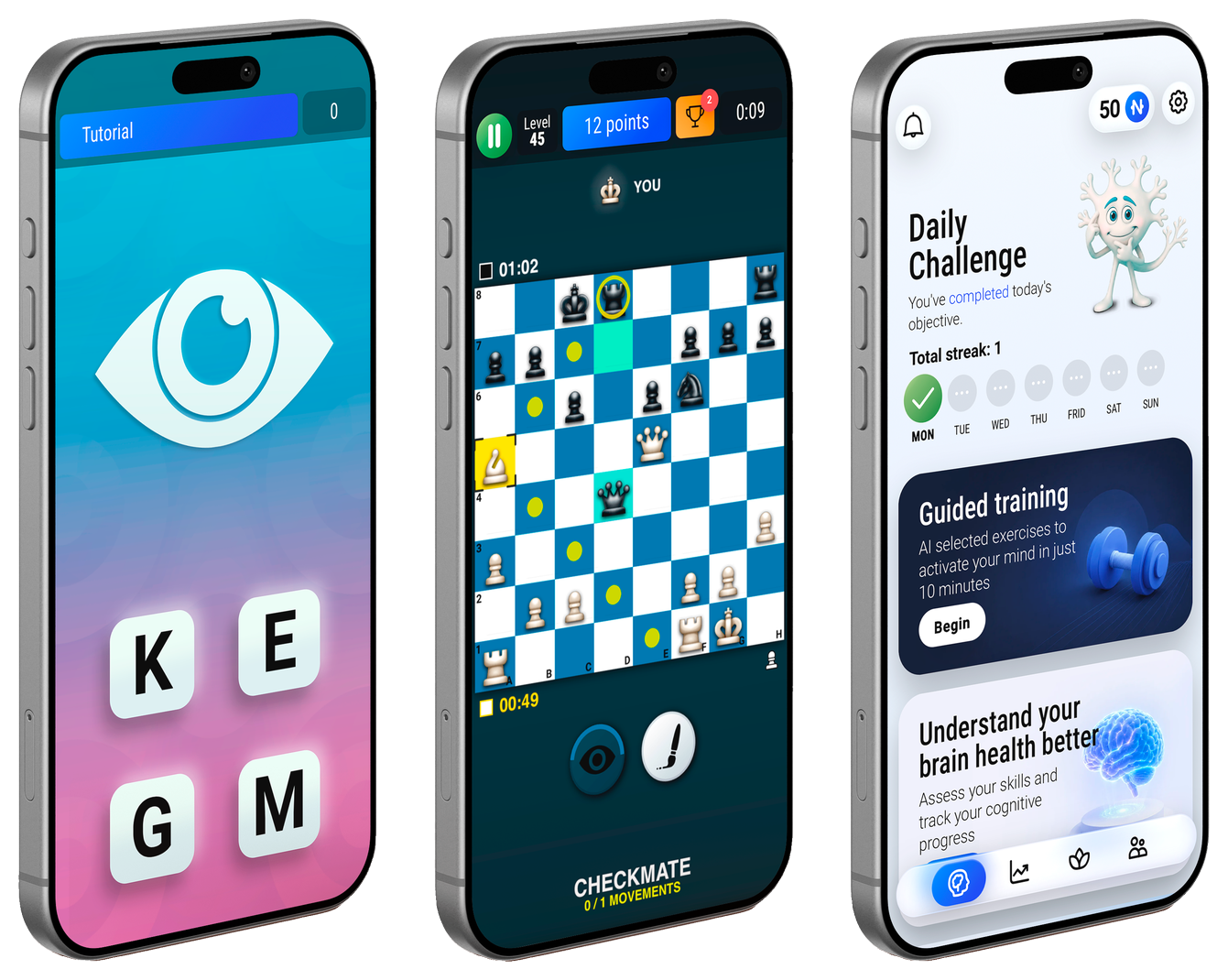
CogniFit app on three phones: visual-perception task, chess training, and the daily cognitive training plan
Why it matters

Your brain ages before your body does.

Cognitive change is one of the earliest signals of aging, and one of the most modifiable. Memory, attention and processing speed shape everyday independence long before they ever feel like a clinical issue.

45%

of dementia cases are tied to 14 modifiable risk factors in the 2024 Lancet Commission. Cognitive engagement is one population-level lever, not a guarantee for any individual. Lancet Commission, 2024

1 in 5

adults over 50 already show measurable mild cognitive impairment, decline beyond normal aging that often shows years before it disrupts daily life. See the evidence guide

The space between that first measurable change and a clinical problem is the window this page is about. Those are the years when training the right abilities can do the most.

IndependenceMemory and attention support routines, errands, medication schedules and confidence outside the home.

Decision-makingProcessing speed and executive function affect planning, judgment and the ability to adapt when something changes.

Quality of lifeFrequent forgetfulness adds friction and stress, which can make daily life feel smaller than it needs to.

Staying connectedWord-finding and memory shape conversation and social confidence, and social isolation is itself one of the Lancet's modifiable risk factors.

What it trains

The everyday abilities that keep you sharp

Memory, attention, speed, perception and coordination decide how confidently you handle daily life, from following a conversation to staying safe behind the wheel. CogniFit profiles your cognitive skills across these five domains and focuses your training on the ones with the most room to grow.

Memory
2 skills
Working memory
Holds the elements you need in mind while you carry out a task, like names, numbers or a set of instructions.
Short-term memory
Temporarily retains a small amount of information, like the start of a sentence you are still reading.
Attention & speed
3 skills
Divided attention
Lets you carry out more than one task at once, quickly and efficiently, the basis of safe multitasking.
Processing speed
The time it takes to take in information and complete a mental task, a core marker of cognitive aging.
Response time
How quickly you react to something once it appears, from a road hazard to a ringing phone.
Perception
2 skills
Visual perception
Turns the light reaching your eyes into a meaningful image, including detail, contrast and recognition.
Spatial perception
Awareness of where you are in relation to the environment and to yourself, used in driving and navigation.
Coordination
1 skill
Eye-hand coordination
Unites visual and motor skills so the hand is guided by what the eyes see. It underpins balance and mobility.
Executive function
3 skills
Planning
The ability to think ahead and mentally anticipate the right way to reach a goal before you start.
Shifting
Adapting flexibly when the rules or the situation change; closely tied to fluid reasoning.
Naming
Retrieving and referring to an object, person or idea by its proper name, without the "tip of the tongue" delay.

Definitions adapted from CogniFit's cognitive-skills science pages. The Cognitive Assessment Battery is a wellness assessment, not a clinical diagnostic test.

The science

Backed by research, and honest about it

CogniFit's tasks turn up in peer-reviewed studies of older adults. The results are encouraging and, like the whole field, mixed in places. Here is the evidence this page leans on. Every link opens the full study, numbers and limits included.

Adults over 60

A 2026 controlled study found adults over 60 improved on a global cognitive score after 12 weeks of training, with the gain confirmed on the independent MoCA test. Read the breakdown ↗

Commercial programs review

A 2017 review placed CogniFit among the better-evidenced brain-training programs, while noting the field's evidence is mixed. Read the breakdown ↗

Sleep and cognition

Older adults with insomnia improved their sleep and focus in a small trial. Read the breakdown ↗

Mobility in seniors

Cognitive training improved walking speed in sedentary older adults, most clearly when walking while doing a second task. Read the breakdown ↗

The experience

A few minutes a day, and you can watch it working

CogniFit is built to feel less like a test and more like a short daily game, with your progress visible the whole way. Here is what it is actually like to use.

01

A quick check-in, not an exam

You start with a 10 to 15 minute assessment that plays like a set of games, mapping where your memory, attention and processing speed stand today.

02

A plan that is actually yours

CogniFit builds a daily routine around the abilities with the most room to grow, so you are never just playing random games to pass the time.

03

Short sessions that pull you in

Each round is a handful of fast challenges that adapt as you improve, staying just hard enough to keep you focused without tipping into frustration.

04

Progress you can watch

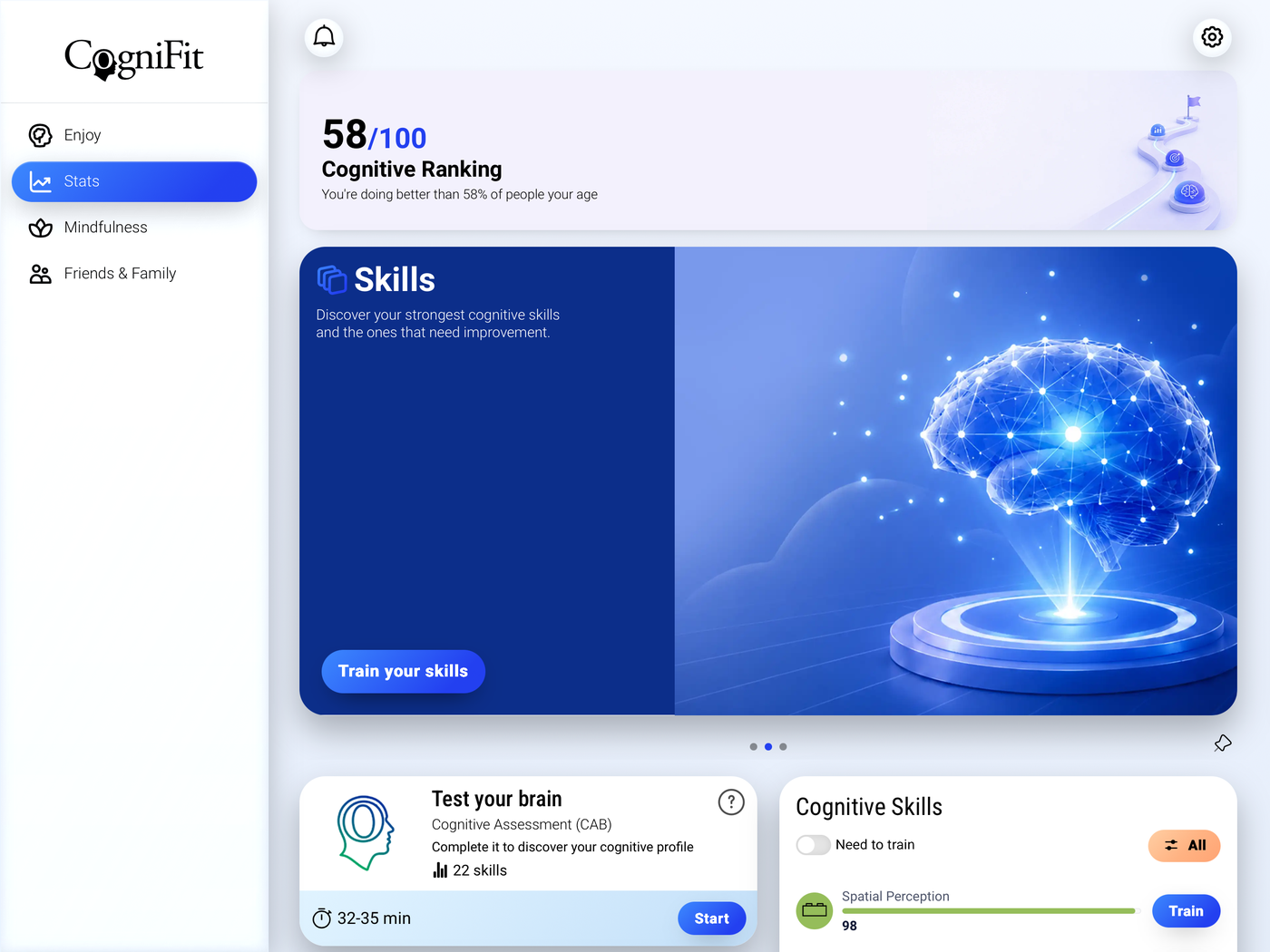
Your cognitive age and domain scores move as you train, so improvement is something you can see for yourself, not just take on faith.

CogniFit screen showing the cognitive-skills profile, a brain visualization of trained abilities, and a Test your brain assessment
What to expect

What you can expect if you keep showing up

No program can promise you a specific number. But across CogniFit's own data with older adults, consistent training shows a clear pattern of gains on the abilities you practice. Here is roughly what that has looked like.

1,125
Older adults, measured before and after

trained on CogniFit's Cognitive Assessment Battery, then measured again. This is observational program data, not a lab trial, so read it as a pattern to expect, not a promise.

+47% average memory gain after about 50 sessions, in adults aged 50 to 92, the change people notice most.
+68% improvement in coordination, the largest single change in the same group of older adults.
+20% in cognitive performance among a separate group aged 60 to 70 who trained about 3 times a week for 4 months.

Source: CogniFit internal studies (2019–2024). Observational pre-post data without a randomized control group, not proof of efficacy. Gains are largest on the abilities directly trained and in older users, who start from a lower baseline.

Who it's for

Built for individual routines and professional programs

For adults, CogniFit works as an assessment-first training routine for memory, attention and focus. For organizations, the same engine supports supervised cognitive stimulation, research protocols and structured wellbeing programs.

Care-home usability signal: CogniFit's internal elderly-care material reports a user survey with an average age of 71.7; 89% found it easy or very easy to use and 86% would recommend the program. This supports product fit in supervised older-adult settings, not cognitive effectiveness. Source: CogniFit internal elderly-care material.

FAQ

Frequently asked questions

Does brain training prevent or reverse dementia?

No brain-training program can prevent, cure or reverse dementia, and you should be cautious of any that claims to. But the evidence is not nothing: the 2024 Lancet Commission counts cognitive engagement among the modifiable factors tied to about 45% of dementia cases, and the large ACTIVE trial found that reasoning and speed training delayed cognitive decline, with benefits still measurable up to 10 years later. What is well established is that training improves the abilities you practice; reliable disease prevention for any one person is not. See the evidence guide for the full picture. Livingston et al. 2024, Lancet Commission

How long until I see results?

In CogniFit's own data with older adults, memory rose about 47% after roughly 50 sessions, and gains build with consistent training. It is observational program data, so the pace differs from person to person. Source: CogniFit programme data (observational).

Is CogniFit scientifically validated?

Yes, within limits worth stating. CogniFit's research catalogue indexes 209 published studies, reviews, theses and conference reports that have used or evaluated its cognitive assessment or training, including a 2026 study in adults over 60 (SAGE Open). Findings across the field are mixed, and the science section below links the primary sources.

How much time does it take?

Sessions are short and adaptive, typically a few times per week. Difficulty adjusts in real time to keep each task inside the right challenge zone.

Who is CogniFit brain training for?

Adults who want to maintain memory, attention and processing speed; older adults; and supervised settings such as elderly care homes, which have a dedicated CogniFit program.

Does it work on phone and computer?

Yes. CogniFit runs on smartphone, tablet and desktop, and syncs your assessment and training plan across devices.

Published by CogniFit, a cognitive training provider. This page is educational and is not medical advice. CogniFit training is a general wellness program, not a disease treatment. Talk to a doctor about any medical condition or symptom.

Train the skills that help you stay sharp as you age.

Start with an assessment, get a personalized plan, and follow your cognitive progress over time.

Start training with CogniFit