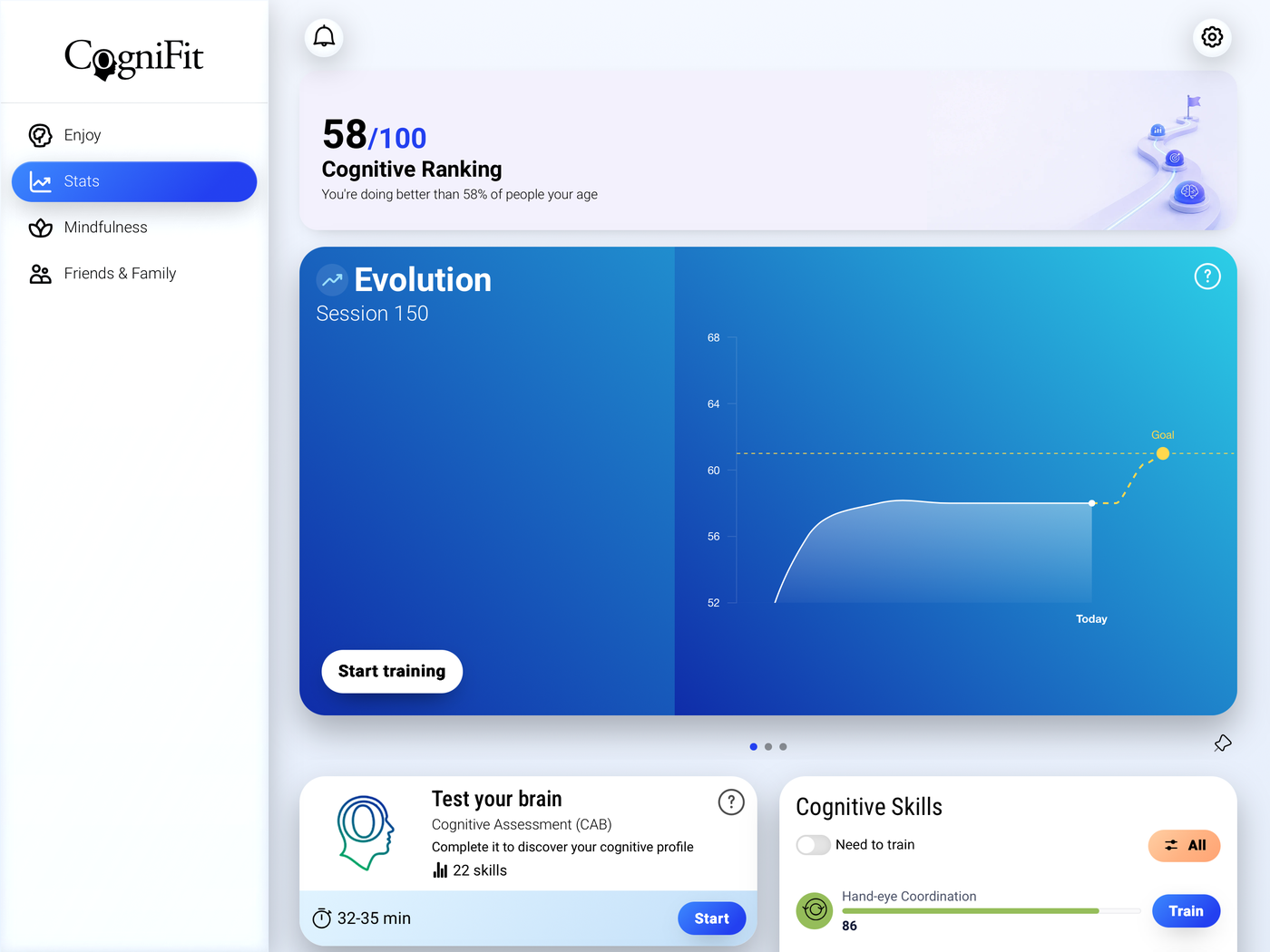
Give every resident a personalized brain-training routine that feels like a game, and give your team a simple way to measure the difference and share it with families. All on one tablet.
Designed to support residents' cognitive wellbeing. Individual results may vary.
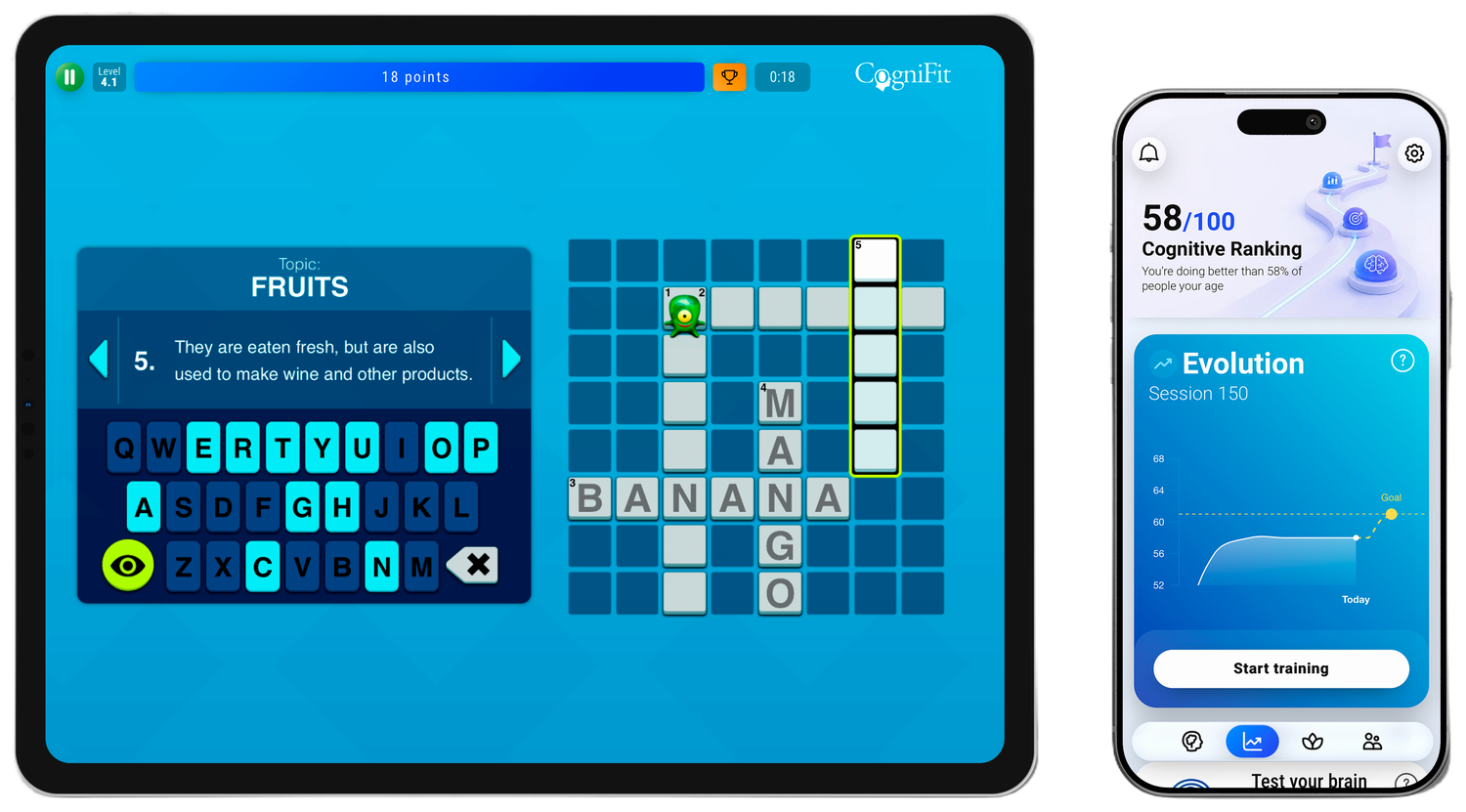
Residents want to feel capable, and homes increasingly need to show that care is active, not passive. The thing that is hard to find is an activity that is personal, measurable, and one residents genuinely want to do.
Personal. Built around each resident's own abilities, not a generic worksheet everyone gets.
Measurable. Progress you can show by cognitive domain, in care notes and family updates.
Enjoyable. Game-like sessions residents look forward to, so engagement lasts past the first week.
Cognitive engagement is one of the modifiable factors the 2024 Lancet Commission links to dementia risk at the population level, one lever among many, not a guarantee for any individual. See the evidence guide.
CogniFit runs on a tablet and plays like a friendly game. It is the same engine as CogniFit's consumer brain-training program, adapted for supervised, group-care use. Here is what it looks like for everyone it touches.
Sits down with a tablet and plays a few short, friendly games that adjust to them. No pass or fail, just a small win they can see, a few times a week.
Sets each resident up once, then mostly supervises. The program picks the right exercises and keeps the scores, so staff spend their time with residents, not on admin.
Gets something concrete: a simple picture of how their relative is doing, and reassurance that the home is keeping them mentally active.
No program can promise a result for any one resident. Across CogniFit's own data with older adults, the pattern is consistent: first whether they will use it, then what changes when they do.
Source: CogniFit internal studies (2019–2024) and the Cognitive Stimulation for Elderly Care Homes material. Observational pre-post data without a randomized control group, plus usability feedback, not proof of efficacy. Gains were more pronounced in residents over 70, who start from a lower baseline.
Try it with a small group of residents and see how they take to it before rolling it out more widely.
It runs on a tablet you already have. Each resident is assessed once, and the program builds their plan.
Your team has what it needs to run sessions and pull progress, with help available whenever you want it.
CogniFit's approach draws on peer-reviewed studies of cognitive training in older adults. The results are encouraging and, like the whole field, mixed in places.
Some trials found no advantage over an active control. The balanced evidence review keeps positive and null results together, and CogniFit is a wellness program, not a treatment for dementia.
Setup happens once per resident, and the sessions run themselves. Staff mainly supervise, help residents who want assistance, and check progress when it suits them. It is built to fit an already stretched team, not to add to it.
No. It runs on a tablet, plays like a simple game, and works for assisted or one-to-one use. In CogniFit's care survey of older users (average age 71.7), 89% found it easy or very easy to use. Source: CogniFit care survey.
No. Each resident is assessed first, then given a personalized plan, and progress is measured by cognitive domain rather than just time spent playing.
Yes. CogniFit's tasks are used in peer-reviewed studies of older adults. See the science above for the studies behind the product and their limits.
Yes. Each resident's scores update by cognitive domain, so you can include them in care notes, family updates and quality reporting.
A tablet and a few minutes per session. No special hardware and no installation beyond the app.