







CogniFit Publishes First Global Survey of Cognitive Health Professionals
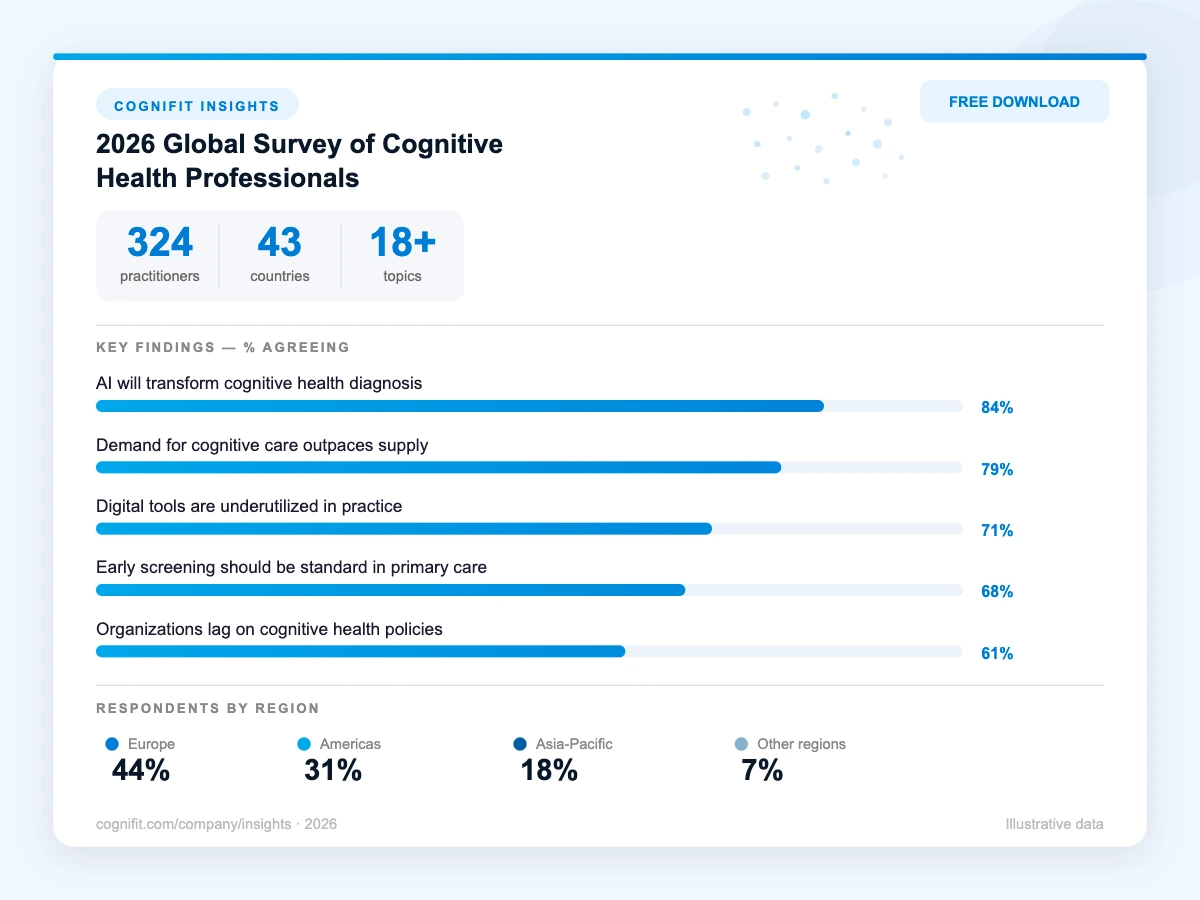
324 practitioners across 43 countries reveal that cognitive health is leaving the clinic — and that employers, insurers and pharma are not keeping pace.
The takeaway
CogniFit's first Global Survey of Cognitive Health Professionals gathered input from 324 practitioners in 43 countries and finds the field shifting from a clinical specialty into a lifelong, everyday practice — while practitioners say employers, insurers and pharmaceutical companies are not keeping pace.
- 89% of professionals say employers, insurers and health systems should do more to build brain health into their programs.
- The dominant view (39%) sees cognitive health as a category spanning healthcare, education, the workplace and longevity — not just a clinical tool.
- Practitioners trust AI for admin tasks like report generation far more than for clinical decision support.
- Cost, not technology readiness, is the biggest obstacle practitioners cite to scaling cognitive health services.
- The survey was run with independent research firm SharpBrains among engaged early adopters, so results are directional signals rather than a representative snapshot.
A quiet paradigm shift in cognitive health
CogniFit, a global pioneer in digital cognitive assessment and training, today released the results of the 2026 Global Survey of Cognitive Health Professionals, conducted on its professional platform in collaboration with independent market research firm SharpBrains. Carried out in English and Spanish, the survey gathered responses from 324 practitioners across 43 countries — working with populations that range from children with ADHD and learning difficulties to adults pursuing peak performance and older adults managing brain aging.
The findings paint a field undergoing a quiet paradigm shift: cognitive health is no longer seen as a clinical specialty for the sick, but as a lifelong practice for everyone — spanning healthcare, education, the workplace and longevity.
The single strongest signal in the survey is a call to action. 89% of professionals agree that organizations — employers, insurers and health systems — should do more to incorporate brain health into their programs, with only 3% disagreeing. A further 76% believe the cognitive side-effects of drugs and anesthesia should be more closely monitored, a message aimed squarely at pharmaceutical companies and regulators.

Key findings
Six numbers, drawn from 324 professionals in 43 countries, capture where the field is heading.
Why CogniFit is positioned to take the field's pulse
CogniFit is uniquely positioned to take the field's pulse. Its platform is used by clinicians, neuropsychologists, researchers, educators and health organizations in more than 20 languages, giving the company direct reach into the working reality of cognitive health professionals worldwide.
The survey was designed with SharpBrains to detect early signals rather than to produce a statistically representative snapshot — respondents are engaged early adopters whose views act as a leading indicator of where hospitals, schools and workplaces are heading.

From CogniFit's CEO
“For decades we treated the brain the way we treated the heart before the 1970s: we only looked when something went wrong. These 324 professionals across 43 countries are telling us that era is over. Cognitive health is becoming as measurable, trainable and routine as cardiovascular health — and any organization that does not build it into its health, education or workplace programs will simply arrive late.”
Where practitioners trust — and don't trust — AI
Only 6% of practitioners would refuse to use AI at all, but their comfort is highly selective by task.
From clinic to everywhere
The call on institutions is equally pointed. 39% of respondents — the dominant view — see the future of cognitive health as a transversal category spanning healthcare, education, the workplace and longevity, while only 8% see it primarily as a clinical assessment tool for neurological conditions. Professionals favor strikingly early routine checkups, with 'under 18' the most cited starting age and a clear majority backing screening before 50.
Cognitive care has also already left the clinic: at-home use now accounts for 35% of reported settings, close behind the 41% in clinics — yet only 22% of professionals track cognitive progress continuously through digital tools.

From SharpBrains' CEO
“What these 324 professionals are telling us is that the conversation has moved from whether cognitive health matters to how to deliver it at scale — across the full span of a human life, not only when something goes wrong. The strongest signal of all is a call to action for employers, insurers and pharma: 89% of practitioners believe organizations should do more to incorporate brain health into their programs.”
What's holding the field back
The obstacles practitioners cite are practical, not technological.
Methodology
The 2026 Global Survey of Cognitive Health Professionals was conducted online, in English and Spanish, among 324 professionals using the CogniFit professional platform, and was designed in collaboration with SharpBrains to detect early signals in the field. Respondents included neuropsychologists, psychiatrists, primary care and occupational health professionals, psychologists, therapists, educators and researchers.
A total of 43 countries are represented; the top six countries account for 75% of the sample, with the remaining 25% spread across 37 countries. Respondents are engaged early adopters rather than a statistically representative sample of all clinicians, so results should be read as directional signals of where the field is heading. Full methodology notes are available in the downloadable report. The survey was not sponsored by any pharmaceutical, insurance or employer-side organization.

Read the full findings & download the report
The full report includes country-level breakdowns, specialty-by-specialty analysis and an op-ed by CogniFit leadership.
About CogniFit
CogniFit is a global pioneer and leader in cognitive healthcare. Since 1999, the company has built one of the world's most widely used digital platforms for cognitive assessment and training — an FDA-registered solution available in more than 18 languages and trusted by clinicians, neuropsychologists, researchers, educators and health organizations worldwide. The platform enables professionals to assess, monitor and train cognition across the entire lifespan — from developmental conditions such as ADHD to peak performance, healthy aging and longevity.
Frequently asked questions
What is the 2026 Global Survey of Cognitive Health Professionals?
It's CogniFit's first global survey of cognitive health professionals, conducted with independent research firm SharpBrains among 324 practitioners across 43 countries, covering populations from children with ADHD and learning difficulties to adults pursuing peak performance and older adults managing brain aging.
Who took part in the survey?
Respondents included neuropsychologists, psychiatrists, primary care and occupational health professionals, psychologists, therapists, educators and researchers, using the CogniFit professional platform in 43 countries.
Is the survey representative of all clinicians?
No. Respondents are engaged early adopters rather than a statistically representative sample of all clinicians, so the findings should be read as directional signals of where the field is heading, not a definitive census.
Was the survey sponsored by a pharmaceutical, insurance or employer organization?
No. The survey was not sponsored by any pharmaceutical, insurance or employer-side organization.
 United States